


Ranking basics
Base rank
A player's ranking is always between 0 and 1000. In each MERS tournament he can obtain a base rank between 0 and 1000. The player's total ranking is a weighted average of his obtained base ranks from the tournaments he has participated in.A player who wins all his tournaments, will have a total ranking of 1000.
A player who loses all this tournaments, will have a total ranking of 0.
Weight
Results from certain tournaments, count more towards a player's ranking, than results from local tournaments do. These weights are related to the MERS qualification of a tournament:- MERS5 : OEMC and WMC count five times,
- MERS2 : national championships count two times
- MERS1 : and other (local) tournaments count only once.
Also, player's older results count less towards his ranking, than his more recent results do.
Since July 12th 2010, rules change :
- Tournaments over one year old count for 66,66%
- Tournaments over two years old count 33,33%
- and when a result is over three years old, it will no longer contribute to the MERS.
Minimum requirement
To establish a representative ranking five results are needed. A player is required to have participated in at least two tournaments to appear on the ranking and a player with less than five tournaments is given a result of 0 (weight 1) for each missing tournament.Calculation
A player's base rank in a tournament is based on his place in the tournament compared to the other participants:- If you win you get a base rank of 1000.
- If you are in the middle of the field you get a base rank close to 500.
- If you are number 75 out of 100 you get a base rank of 252.
- If you are last of 100 players, you get a base rank of 0.
The base rank is calculated as follows:
- Find the number of player's you have beaten by taking the number of players and subtract your position.
- Divide by (number of players minus 1).
- Then multiply by 1000 to avoid small numbers.
Example: there are 100 players.
Consider the player
who got the 25th place.
Base rank: (100-25) / (100-1) * 1000 = 757.
Averaging
Since July 12th 2010, rules change : It's composed by 2 parts.
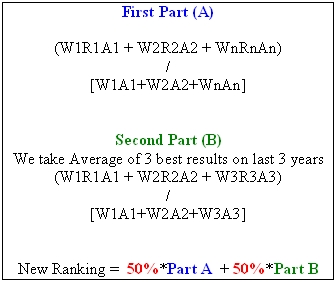
With W=Weight, R=base rank, A=Age of tournament
First part is made with average of all tournaments (in the last three years) and the base ranks he has obtained. Note that all tournaments are rated differently (with weight) and count less in the time.
Second part is made with average of three best results (base rank) during last three years. Note that all tournaments are rated differently (with weight) and count less in the time.
Reporting Results
Sébastien Berret is maintaining the MCR and Riichi ranking database, so organizers are kindly asked immediately after tournaments to:- always use this Excel sheet for reporting tournament results
- always check that all EMA ID's for European players are correct. (Non-European players don't have EMA ID's.)
- Use this form to send the results to Sébastien.
Update : 12/07/2010
